Most VMware administrators start their VCF journey by asking the wrong question.
“What do I need to memorise to pass the exam?”
The better question is:
“What problem was VMware Cloud Foundation created to solve?”
Once you understand the answer, the certification becomes dramatically easier.
More importantly, you become a better administrator.
Because VMware Cloud Foundation is not simply another VMware product.
It is VMware’s attempt to solve one of the biggest problems facing modern infrastructure teams:
Complexity.
The Problem VMware Is Trying to Solve
Think back to a traditional VMware environment.
You might have:
A vCenter Server.
Several ESX clusters.
A SAN managed by the storage team.
Physical networking managed by the network team.
Firewalls managed by the security team.
Monitoring tools managed by operations.
Automation tools deployed separately.
Backups configured independently.
Every component works.
But every component also has its own lifecycle.
Its own upgrade path.
Its own support matrix.
Its own dependencies.
Its own operational procedures.
Over time these environments become increasingly difficult to maintain.
Upgrading vSphere becomes a project.
Upgrading networking becomes another project.
Upgrading storage becomes another project.
Soon the infrastructure team spends more time maintaining infrastructure than delivering value.
VMware looked at this challenge and asked:
“What if the entire private cloud operated as a single platform?”
That idea became VMware Cloud Foundation.
Understanding VMware Cloud Foundation
Many people describe VMware Cloud Foundation as:
vSphere + vSAN + NSX + SDDC Manager
Technically that is correct.
But it misses the real value.
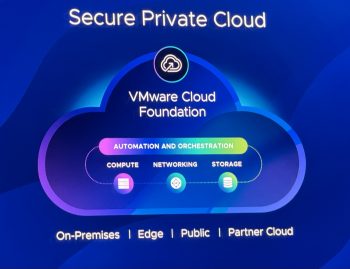
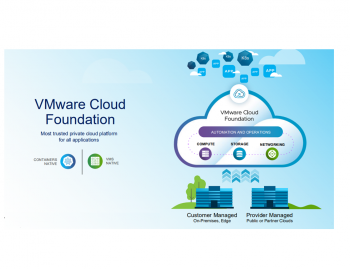
VMware Cloud Foundation is an operating platform for private cloud.
Just as Azure operates public cloud infrastructure.
Just as AWS operates public cloud infrastructure.
VCF provides a consistent operating model for on-premises infrastructure.
The platform combines compute, networking, storage, security, automation, operations, lifecycle management, identity management, and Kubernetes into a single architecture.
This is the first mindset shift required for the certification exam.
Do not think in products.
Think in platforms.
The exam increasingly tests how components interact rather than how individual features operate.
Why vCenter Still Matters
One misconception I frequently hear is:
“VCF replaces vCenter.”
It does not.
In fact, vCenter remains one of the most important components in the entire platform.
VMware vCenter continues to act as the control plane for compute operations.
Every ESX host ultimately reports into vCenter.
Every virtual machine is managed through vCenter.
Every cluster, datastore, resource pool, DRS recommendation, HA action and vMotion operation flows through vCenter.
Even in VCF 9, vCenter remains the heart of compute management.
The difference is that vCenter is no longer expected to manage the entire private cloud lifecycle.
That responsibility now belongs elsewhere.
Enter SDDC Manager
This is where many certification candidates get confused.
They know vCenter.
They understand ESX.
But they struggle to understand why VMware introduced SDDC Manager.
The answer is simple.
vCenter manages infrastructure resources.
SDDC Manager manages the platform.
That distinction is incredibly important.
When VMware Cloud Foundation performs:
Certificate management
Password management
Domain deployment
Lifecycle management
Fleet management
Platform upgrades
Workload domain operations
These activities are orchestrated through SDDC Manager.
Think of SDDC Manager as the cloud operating system.
Think of vCenter as the compute management plane.
Understanding this relationship immediately makes a large portion of the VCF architecture easier to understand.
What Changed in VCF 9?
VCF 9 represented one of the biggest architectural shifts VMware has made in years.
Historically, VMware environments often felt like collections of products.
VCF 9 moved aggressively toward platform integration.
The focus shifted toward:
Unified operations
Fleet-level lifecycle management
Kubernetes integration
AI-ready infrastructure
Security by default
Private cloud as a service
Infrastructure teams increasingly want public-cloud-like operations without losing control of data.
VCF 9 was VMware’s answer to that challenge.
The result is a platform that treats virtual machines, Kubernetes workloads, AI workloads, networking, storage, and security as first-class citizens inside a unified private cloud architecture.
Why NSX Became So Important
Many VMware administrators have spent years focusing primarily on vSphere.
For the VCF exam, that approach can become a problem.
Because modern VMware Cloud Foundation is built around NSX.
In traditional environments, networking often relied heavily on physical infrastructure.
VLANs.
Firewalls.
Routing.
Load balancing.
Security policies.
Much of this was configured outside the VMware stack.
VCF changes that approach.
NSX brings networking into software.
The network becomes programmable.
Security becomes programmable.
Routing becomes programmable.
Load balancing becomes programmable.
This shift is one of the most important concepts in the entire VCF architecture.
Understanding NSX is no longer optional.
It is foundational.
When you deploy a workload domain today, networking is no longer simply “connected.”
It becomes an integrated part of the cloud platform itself.
This is why so many exam objectives focus on troubleshooting NSX gateways, routing, DHCP, VPN services, VPCs, and network operations.
VMware expects administrators to understand how the software-defined network behaves.
Not just how virtual machines connect to it.
What Is New in VCF 9.1?
VCF 9.1 is not a complete redesign.
It is an optimisation release.
VCF 9 introduced the architecture.
VCF 9.1 improves how that architecture operates at scale.
One major improvement is around operational efficiency.
VMware enhanced NVMe Memory Tiering, allowing hot data to remain in DRAM while colder pages move intelligently to NVMe storage. This improves memory efficiency and reduces infrastructure costs without changing how applications behave.
For administrators studying the exam, this matters because VMware continues pushing toward software-defined infrastructure where hardware resources are utilised more efficiently.
VCF 9.1 also introduces significant improvements around Kubernetes scalability.
Supervisors can support dramatically larger Kubernetes deployments, allowing platform teams to manage both containerised and traditional workloads using the same operational model.
Another area receiving major investment is networking.
VCF 9.1 expands VPC capabilities, transit gateway functionality, IP address management, and multi-site connectivity options directly through vCenter and NSX.
This is important because VMware is positioning VCF not simply as a virtualisation platform, but as a complete private cloud platform.
The networking layer is becoming increasingly intelligent and increasingly automated.
vCenter in VCF 9.1
Even vCenter receives important improvements.
One particularly useful enhancement is the ability to resize vCenter resources through a simple API-driven process rather than requiring more complex operational procedures.
This may sound like a small feature.
But it reflects VMware’s broader strategy.
Reduce operational friction.
Reduce manual administration.
Increase automation.
The same philosophy appears throughout VCF 9.1.
The Most Important Lesson for Exam Candidates
If there is one lesson I would give every VCF certification candidate, it is this:
Stop studying individual products.
Start studying the platform.
Understand how:
ESX supports vCenter.
vCenter supports workload operations.
NSX provides networking.
vSAN provides storage.
SDDC Manager provides lifecycle management.
VCF Operations provides observability.
Identity Broker provides authentication.
VCF Automation provides self-service consumption.
When you understand those relationships, the blueprint begins to make sense.
And when the blueprint makes sense, the exam becomes far less intimidating.
Because VMware is not testing whether you can memorise menu options.
They are testing whether you understand how a modern private cloud platform operates.
That understanding is what ultimately separates a VMware administrator from a VMware Cloud Foundation administrator.